


Volta a Portugal Dictionary
Cycling has a language of its own. During Volta a Portugal broadcasts, it is common to hear expressions that may not be familiar to those who only follow the sport occasionally. To help you enjoy the race even more, we have gathered some of the most common terms used by commentators, journalists, teams and riders.
Abanico
A race situation caused by crosswinds, in which riders form an echelon to shelter from the wind and reduce air resistance. As road space is limited, not everyone can fit into the formation. Riders left behind lose this protection, become more exposed to the wind and gradually lose time, creating splits in the peloton and significant gaps in the overall classification.
Elevation Profile
A graphical representation of a stage profile, showing the distance, climbs, descents and total elevation gain.
Neutral Support
Technical assistance provided by the race organisation to all riders, regardless of their team. In the event of a puncture, mechanical problem or other technical issue, neutral support can provide a replacement bicycle or wheel, allowing the rider to quickly rejoin the race. On extremely hot days, it may also supply water to riders.
Blackboard
A board displayed by the race organisation, usually from a motorcycle, showing riders the time gaps between the breakaway, the peloton and other groups on the road.
Attack
A sudden acceleration by one or more riders with the aim of breaking away from their rivals.
Water Carrier (Domestique)
A rider responsible for carrying water, food and other supplies to teammates during the race.
Time Bonus
Seconds deducted from a rider’s total time in the General Classification. Time bonuses may be awarded at the finish of certain stages or at intermediate sprints (Intermediate Sprints or Hot Spots), rewarding the first riders across the line.
Cadence
The number of pedal revolutions per minute (RPM).
Leader’s Jersey
The jersey worn by the leader of a specific classification. In the Volta a Portugal there are four official jerseys: Yellow (General Classification), Blue (Mountains Classification), Orange (Points Classification) and White (Young Rider Classification).
Race Caravan
The convoy of official vehicles accompanying the race, including organisers, teams, commissaires, medical services, neutral support, media and partners.
Team Car
The official team vehicle that follows the race, providing mechanical assistance, food and tactical support to its riders.
Advertising Caravan
A convoy of promotional vehicles from the Volta a Portugal partners that travels the route before the riders, distributing gifts and entertaining spectators along the course.
Sweep Vehicle
The final vehicle in the race caravan. It officially closes the race and ensures that no rider is left behind without assistance.
General Classification
The overall classification based on the combined times of all stages. The leader wears the Yellow Jersey.
Commissaire
The race official appointed by the Union Cycliste Internationale (UCI) or the Portuguese Cycling Federation to ensure that the competition regulations are respected throughout the event.
Individual Time Trial (ITT)
A stage raced individually against the clock. Each rider starts alone, and the winner is the rider who completes the course in the fastest time. In this edition of the Volta, it will take place on the sixth day between Anadia and Águeda over a distance of 17 km.
Split
A separation in the peloton caused by high speed, crosswinds or the difficulty of the terrain, leaving groups of riders behind.
Litter Zone
A designated area where riders may safely discard empty bottles, food wrappers and other waste, helping to protect the environment and keep the race route clean.
Sports Director
The person responsible for the team’s race strategy, communicating with the riders via race radio.
Stage
Each day of competition in the Volta a Portugal. The 2026 edition consists of a Prologue and ten stages.
Queen Stage
The most demanding stage of the race, usually featuring the greatest amount of climbing and often proving decisive for the General Classification. Due to its difficulty and prestige, the double ascent of Alto da Senhora da Graça on the penultimate day could become the decisive stage of this edition.
Breakaway
A group of riders that succeeds in pulling away from the peloton, aiming to reach the finish ahead or score points in the intermediate classifications.
Domestique
A rider who works for the benefit of the team leader by protecting them from the wind and rivals, controlling the race, carrying supplies or assisting them on the steepest climbs.
Lead-out Rider
A rider who prepares a teammate’s sprint by progressively increasing the pace before the finish line.
Intermediate Sprint
A sprint contested during a stage that awards points and/or time bonuses.
Neutralisation
A period during which the race is temporarily stopped or ridden at a controlled pace, with no effect on the classification. This usually occurs because of an accident, adverse weather conditions, obstacles on the road or during the ceremonial start before kilometre 0, where the official race begins.
Peloton
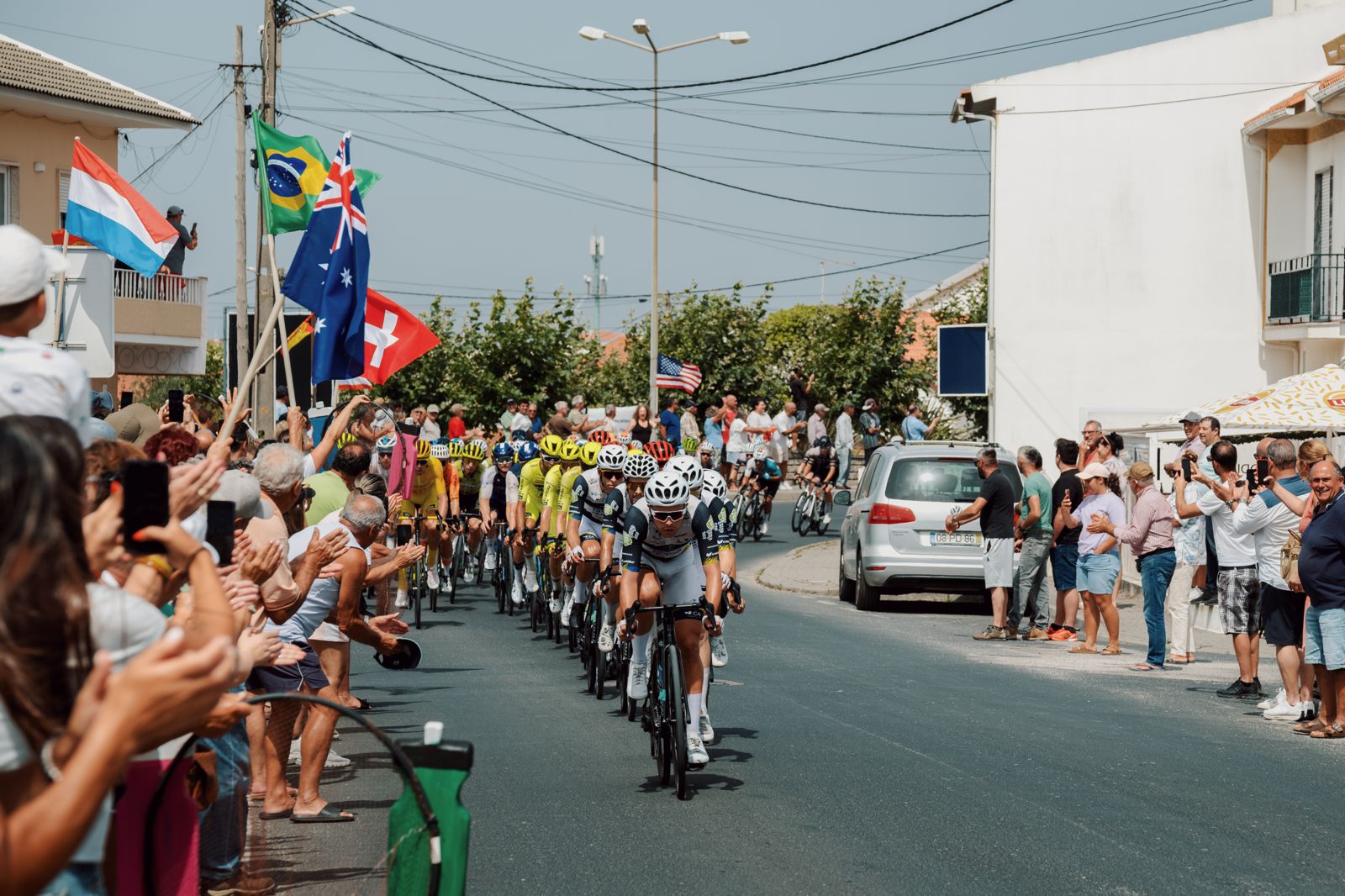
The main group of riders that remains together for most of the race.
Hot Spot
The name given in the Volta a Portugal to a series of intermediate sprint points placed successively over a short section of the course. The first riders to pass each point receive time bonuses for the General Classification. Hot Spots can play an important role in the battle for the Yellow Jersey.
Prologue
A very short stage that opens the race and determines the first overall leader. This will take place on the opening day of this edition in Lisbon.
King of the Mountains
A point located at the summit of a climb where points are awarded to the first riders to reach the top.
Race Radio
The official radio communication system linking Race Direction, commissaires, teams and other race officials, providing important real-time information throughout the event.
Drafting (Riding the Wheel)
A situation in which a rider follows closely behind another cyclist, benefiting from reduced air resistance and saving energy for key moments of the race.
Rouleur
A rider who excels on flat or rolling terrain and is capable of maintaining high speeds over long distances.
Sprinter
A rider who specialises in high-speed finishes and bunch sprints.
Climber
A rider who specialises in mountain stages and steep ascents, typically possessing exceptional climbing ability.
Feed Zone
A designated area defined by the race organisation where team staff may hand riders water, energy drinks, food and other supplies during the stage. It is an essential point for ensuring riders remain properly hydrated and fuelled throughout the race.
